IPL Photofacial vs Microneedling: Tone vs Texture & How to Choose Your First Treatment
Choosing between an IPL photofacial and microneedling can feel overwhelming when you’re new to cosmetic dermatology. The good news? These two popular treatments target completely different skin concerns, which makes the decision more straightforward than you might think. Here’s what you need to know to take your first confident step into professional skin rejuvenation.
Quick Answer: Should You Choose IPL Photofacial or Microneedling First?
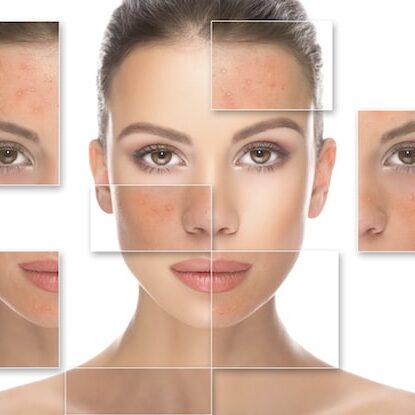
The simplest way to decide between these two treatments comes down to one question: Are you more bothered by your skin tone or your skin texture?
IPL photofacial uses intense pulsed light to address color-related issues—think brown spots, sun damage, redness, and visible blood vessels. Microneedling, on the other hand, triggers your body’s natural healing response to improve surface texture like acne scars, fine lines, and enlarged pores.
Choose IPL if you’re dealing with:
- Sun spots and age spots from years of outdoor exposure
- Freckling that has become more prominent over time
- Redness or flushing across your cheeks and nose
- Broken capillaries or spider veins
- Uneven skin tone or blotchiness
Choose Microneedling if you’re dealing with:
- Acne scars or post-blemish texture
- Fine lines and wrinkles around eyes and mouth
- Enlarged pores that make skin look rough
- General skin dullness and lack of firmness
- Stretch marks on the body
Both treatments are considered “beginner” options at Smart Skin Dermatology, meaning they’re often where new cosmetic patients start their skincare journey. They have the potential to offer real results with minimal downtime, making them ideal first steps before exploring more intensive procedures.
Many patients eventually do both, and most patients require a series of treatments for best results. A board-certified dermatologist can design a sequence that addresses your most pressing concern first, then layers in the other treatment for comprehensive improvement.
In terms of recovery, expect IPL to leave you with some redness and darkening spots that flake off over several days. Microneedling typically causes a “sunburned” look for one to three days. Neither requires significant time away from your normal routine.
What Is an IPL Photofacial? (Intense Pulsed Light 101)
An IPL photofacial is a non-invasive skin treatment that uses broad spectrum light to target unwanted pigment and redness in your skin. Unlike what many people assume, IPL is not a laser treatment. While lasers use a single wavelength of light, intense pulsed light IPL delivers multiple wavelengths simultaneously, allowing it to address both brown discoloration and vascular lesions like redness in the same session.
Here’s how the treatment works at a high level: The light energy penetrates below the skin’s surface, where it’s absorbed by two main targets—melanin (the pigment in dark spots and freckles) and hemoglobin (the red color in blood vessels). When these targets absorb the light, they heat up. Over the following one to three weeks, your body naturally clears away the damaged pigment cells while the treated vessels slowly fade from view.
IPL treatment is particularly effective for:
- Sun damage accumulated over years of outdoor activities
- Photoaging signs like mottled pigmentation
- Freckles that have multiplied or darkened
- Rosacea-related facial redness
- Visible vessels around the nose and cheeks
- Hyperpigmentation from various causes
Think of IPL as a “tone correction” tool. It excels at evening out your skin color, brightening your overall complexion, and reducing blotchiness. What it does not do well is change textural scars or etched-in wrinkles—those require a texture-focused approach.
During an IPL treatment, you’ll feel quick flashes of bright light accompanied by a rubber-band snap sensation and warmth. Your provider applies a cooling gel and you wear protective eye shields throughout the session. Most people describe it as uncomfortable, but tolerable. At times your provider may have you use prescription strength topical anesthesia (numbing cream) prior to treatment.
IPL photofacial treatments are best performed in a dermatology setting like Smart Skin Dermatology, where a trained skin care professional can properly evaluate your spots (ensuring nothing suspicious is overlooked) and calibrate the device for your specific skin type to perform the treatment as safely as possible.
What Is Microneedling? (Collagen Induction for Texture)
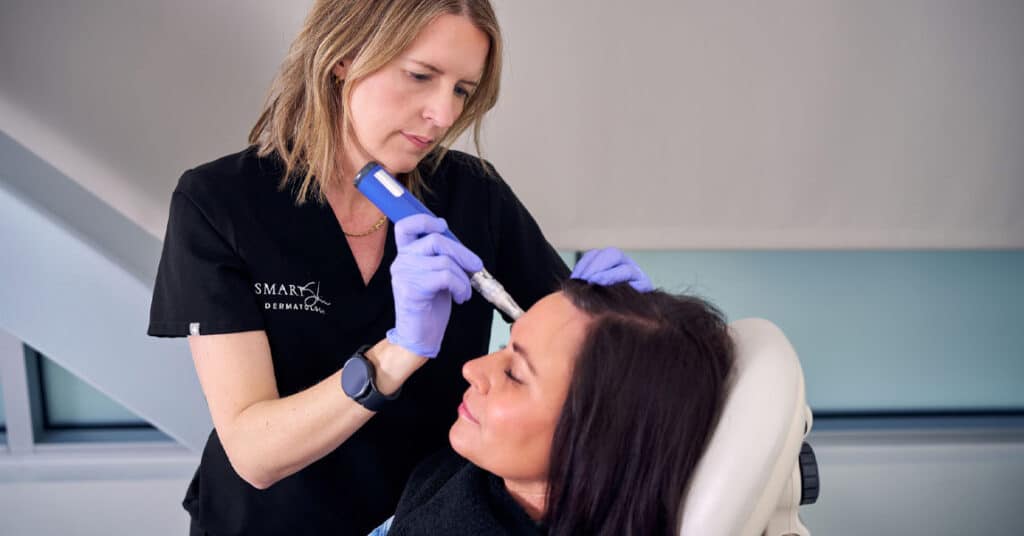
Microneedling is a mechanical, non-light procedure that creates controlled micro-injuries in your skin using tiny needles. A microneedling device—typically a pen-shaped tool with sterilized needles at the tip—passes over your skin, puncturing the surface at precise depths.
These micro-channels trigger something remarkable: your body’s natural healing process kicks into gear. The controlled trauma signals your skin to ramp up collagen and elastin production through three healing phases. First, inflammation releases growth factors. Then, new tissue forms during the proliferation phase. Finally, remodeling strengthens the support structure of your skin for smoother skin texture that develops over weeks to months.
Microneedling treatment primarily addresses:
- Acne scars and post-inflammatory texture changes
- Fine lines and wrinkles, especially around eyes and mouth
- Enlarged pores that create an orange-peel appearance
- Early skin laxity on cheeks and jawline
- Stretch marks on various body areas
- General dullness and uneven texture
Unlike IPL, microneedling doesn’t rely on light or heat targeting specific pigments. This makes it a versatile option for improving skin texture across all skin tones, including darker skin tones where light-based treatments require extra caution.
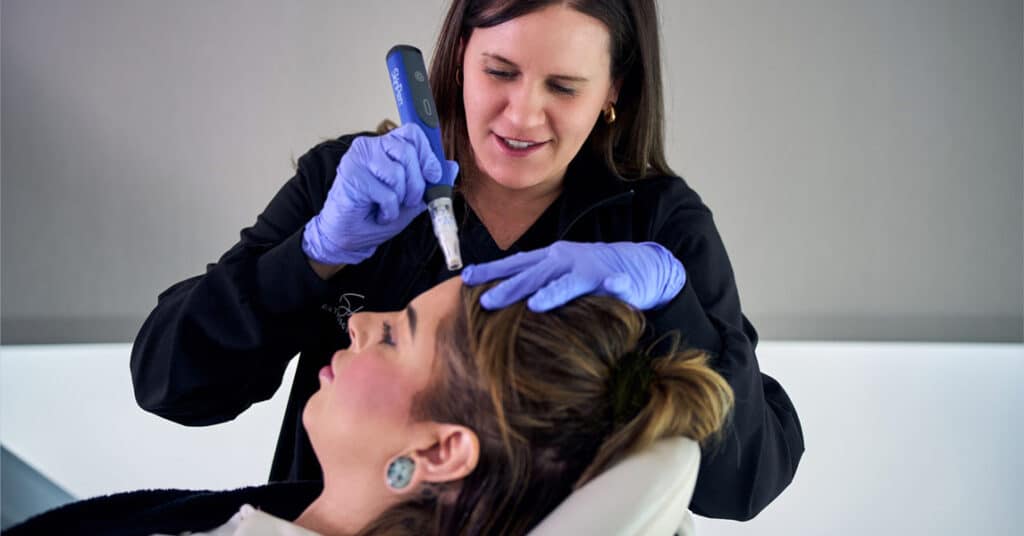
The microneedling treatment involves applying numbing cream for about 20 to 30 minutes before the procedure. Once your skin is comfortable, the provider passes the microneedling device across your face in multiple directions, adjusting needle depth based on the treatment area. Scarred regions may receive deeper passes while delicate areas stay superficial.
At Smart Skin Dermatology, microneedling can sometimes be combined with growth factor serums or other beneficial topicals. The microchannels created during treatment enhance product absorption by up to 80-90%, allowing active ingredients to penetrate far deeper than they would on intact skin.
After the procedure, your skin looks pink to red—similar to a moderate sunburn. Most patients find the sensation manageable, describing it as pressure and vibration rather than sharp pain.
IPL Photofacial vs Microneedling: Tone vs Texture Comparison
The core framework is simple: IPL targets skin tone issues like pigmentation issues and redness, while microneedling targets skin texture problems like scars, wrinkles, and pore size. These treatments work on completely different levels of the skin and address entirely different specific skin concerns.
| Feature | IPL Photofacial | Microneedling |
| Primary Target | Tone (color, pigment, redness) | Texture (scars, lines, pores) |
| How It Works | Light energy breaks down pigment and coagulates vessels | Tiny needles stimulate collagen production |
| Best For | Sun spots, age spots, rosacea, broken capillaries | Acne scars, fine lines and wrinkles, enlarged pores |
| Not Ideal For | Deep scars, etched wrinkles, skin laxity | Removing brown spots, treating redness |
| Typical Sessions | 3-5 sessions | 4-6 sessions |
| Session Spacing | About 4 weeks apart | About 4 weeks apart |
| Skin Tone Suitability | Fitzpatrick I-III (light to medium) | All Fitzpatrick types (I-VI) |
| Downtime | 3-7 days of visible spot darkening | 1-3 days of redness |
Real-world examples make this clearer:
A 55-year-old who spent decades playing outdoor sports and now has brown sun spots scattered across their cheeks and forehead? That’s an ideal IPL photofacial candidate. The treatment will fragment those melanin deposits so the body can clear them away, revealing a more even complexion.
A 30-year-old with pitted acne scars along the cheeks from teenage breakouts and visible pores across the nose? Microneedling is the better starting point. It stimulates collagen production to plump depressed scars and refine pore appearance from the inside out.
Many first-time patients assume these treatments are interchangeable—they’re not. Choosing the wrong one means you won’t see the improvement you’re hoping for, even after multiple sessions.
At Smart Skin Dermatology, new patients typically start with whichever concern bothers them most when they look in the mirror. Is it the blotchy color that makeup can’t quite hide? Or is it the rough, uneven texture that catches light in unflattering ways? That answer guides the first treatment choice, with the option to layer in the other modality later for complete skin rejuvenation.
Benefits & Limitations of IPL Photofacial
IPL is a powerful tool for visible sun damage and persistent redness, but like any treatment, it has clear strengths and boundaries.
Key benefits of IPL photofacial include:
- Brighter, more even complexion. IPL reduces the overall background pigmentation that makes skin look dull or muddy, not just individual dark spots.
- Fading of sun spots and age spots. Clinical studies show 70-80% reduction in hyperpigmentation after three to five sessions.
- Reduction in facial redness. Rosacea symptoms, broken capillaries, and diffuse flushing all respond well to IPL’s vascular targeting.
- Subtle collagen boost over time. While not its primary function, the controlled thermal injury from IPL does trigger some increased blood flow and healing response that can mildly improve skin firmness.
Patients often notice their brown spots darken after treatment—sometimes looking like coffee grounds on the skin. Over seven to fourteen days, these spots flake off or fade, revealing clearer skin underneath. A series of fall or winter treatments, when sun exposure is naturally lower, tends to produce the most dramatic improvement.
Limitations to understand:
IPL does not significantly change deep acne scars, etched wrinkles around the mouth, or skin laxity. If texture is your primary concern, you’ll be disappointed with IPL results because it simply doesn’t work at that level.
IPL is also not ideal for darker skin tones. Because the treatment targets melanin, patients with more pigment in their skin (Fitzpatrick types V-VI) face increased risk of burns or post-inflammatory hyperpigmentation. Even Fitzpatrick IV patients require careful evaluation. This isn’t a flaw of the technology—it’s physics. The treatment works best on Fitzpatrick I-III skin types after thorough assessment by a dermatologist.
Sun avoidance is non-negotiable with IPL. You must avoid tanned skin and self-tanners before treatment, and rigorous sunscreen use afterward is essential to maintain results and prevent new sun damage from undoing your progress.
Benefits & Limitations of Microneedling
Microneedling is a collagen-stimulating procedure that gradually remodels how your skin looks and feels at the surface level. It’s often called collagen induction therapy because that’s exactly what it does.
Key benefits of microneedling include:
- Softening of acne scars. Studies show 50-70% improvement in atrophic acne scars over a series of treatments, with some patients seeing even better results.
- Smoothing of fine lines. The collagen and elastin boost plumps fine lines around the eyes and mouth by 30-50%.
- Reduction in pore size. Patients report up to 80% improvement in the appearance of enlarged pores.
- Mild firming of early laxity. While not a replacement for surgical lifting, microneedling can improve skin elasticity on cheeks and jawline.
- Versatility for body concerns. Stretch marks, surgical scars, and other body texture issues respond to microneedling when performed at appropriate depths.
Results build slowly with microneedling. Unlike IPL, where you see spots darken and flake within days, microneedling improvements emerge over months as new collagen matures. Histology studies show collagen levels increase by approximately 400% at six months post-treatment. Peak improvement typically occurs around three months after completing a series.
Limitations to understand:
Microneedling does not erase broken capillaries or strong redness—those are vascular issues that require light-based treatment. It cannot efficiently remove brown sun spots either. And while it improves mild skin laxity, it will not replace surgery for significant sagging.
Home rollers are not equivalent to professional microneedling. Those devices typically use shorter needles (0.25-0.5mm) that don’t reach the depths needed for real collagen remodeling. In-office treatment at Smart Skin Dermatology uses medical-grade devices with sterilized needles reaching 1.0-2.5mm, creating genuine tissue response under sterile conditions with proper technique.
Consistency matters for microneedling. A single session won’t deliver transformative results. Most patients need three to six sessions, spaced about four weeks apart, to see meaningful improvement. The body’s natural healing cascade takes time, and each treatment builds on the previous one.
Side Effects, Downtime & Recovery: What to Expect
Both IPL and microneedling are considered “beginner” cosmetic options precisely because their recovery is relatively mild when performed properly. Here’s what to realistically expect.
IPL Photofacial Recovery:
Immediately after treatment, expect redness and warmth across the treated area—similar to a mild sunburn. This typically fades within a few hours. The more notable change happens over the following days: brown spots darken significantly, sometimes looking like coffee grounds or pepper flakes on your skin. This is normal and actually indicates the treatment worked.
The cosmetic downtime for IPL runs about three to seven days as these darkened spots gradually flake off. Some patients experience mild swelling, particularly around the eyes if that area was treated. Most providers allow makeup the next day to help camouflage the darkening spots during this phase. Full collagen effects develop over weeks following the healing process.
Microneedling Recovery:
Immediately after the procedure, your skin will be red, tight, and may show pinpoint bleeding in the clinic (this stops quickly). The treated area looks and feels like a moderate sunburn for 24 to 72 hours. Deeper treatments for scarred areas may cause slightly more prolonged redness.
Common guidelines for microneedling aftercare: avoid makeup for 24 hours to let the microchannels close, skip heavy sweating and saunas for one to two days, and stick with a gentle cleanser, bland moisturizer, and strict sunscreen. Your skin is particularly vulnerable during this window, so simplicity is key.
Rare risks for both treatments include blistering, infection, and pigmentation changes. These complications are uncommon when treatments are performed by a board-certified dermatologist using proper protocols. Choosing a qualified provider at a practice like Smart Skin Dermatology significantly reduces these risks compared to spa-level treatments or at-home devices.
Who Is a Good Candidate for IPL Photofacial vs Microneedling?
Ideal treatment selection depends on your skin type, main concern (tone versus texture), medical history, and tolerance for visible downtime during recovery.
Good candidates for IPL photofacial typically have:
- Lighter skin tones (Fitzpatrick I-III, select IV with careful evaluation)
- Bothersome brown spots, sun spots, or freckles from cumulative sun exposure
- Persistent facial redness, flushing, or visible blood vessels
- No recent tanning (natural or artificial) in the treatment area
- No current use of photosensitizing medications
- Willingness to commit to strict sun protection before and after treatment
Good candidates for microneedling typically have:
- Any skin tone from light to dark (no pigment-targeting limitations)
- Acne scars or post-inflammatory texture changes
- Fine lines, early wrinkles, or crepey skin concerns
- Enlarged pores creating rough skin texture
- Interest in collagen building without heat-based risks
- Patience for gradual results over months
Consider these scenarios:
A 35-year-old notices new sun spots and freckling appearing after several beach vacations. Their skin concerns are primarily color-based—they want to restore an even, radiant complexion. IPL photofacial is the right treatment to start.
A 28-year-old has old acne scars along the cheeks and jawline, plus large pores across the nose. The skin imperfections that bother them most are textural, not color-related. Microneedling treatment is the better first step.
Key exclusions apply to both treatments: pregnancy (most providers delay elective cosmetic procedures), active skin infections, open wounds, uncontrolled medical conditions, and recent sun exposure. Smart Skin Dermatology screens for all of these during your consultation to ensure safe, effective treatment.
Some patients benefit from a staged plan based on their priorities. You might start with IPL to clear years of sun damage, then move to microneedling for texture refinement—or the reverse, depending on what bothers you most. Your dermatologist can map out the best sequence for your goals.
How Treatments Feel: During & After Your Visit at Smart Skin Dermatology
Understanding what actually happens during your appointment helps calm first-timer nerves. Here’s a walk-through of each experience.
A Typical IPL Visit:
Your appointment begins with a consultation and skin assessment. The provider cleanses your skin, then applies a cool gel to the treatment area. You’ll wear protective eye shields throughout—the light is bright and could harm unprotected eyes.
The actual treatment involves a series of light pulses across your face. Each pulse feels like a brief, bright flash accompanied by a snapping sensation (often compared to a rubber band) and warmth. Sessions typically last 20 to 30 minutes for a full face. Most patients tolerate IPL without strong numbing, though options can be discussed if you’re particularly sensitive.
Afterward, your provider applies soothing products and sunscreen. You’ll leave with specific aftercare instructions and can typically return to normal activities immediately, though your skin may look pink for a few hours.
A Typical Microneedling Visit:
This appointment starts with numbing cream application to ensure patient comfort. You’ll wait about 20 to 30 minutes for the topical anesthetic to take full effect—bring a book or podcast.
Once numb, the provider passes the microneedling device across your skin in sections, adjusting depth based on the treatment area. The forehead and cheeks often tolerate deeper settings, while areas around the eyes stay more superficial. You’ll feel pressure and vibration more than sharp pain. Deeper passes over scarred areas may feel slightly more intense but remain manageable.
After completing all passes, a calming serum is applied to soothe the skin and take advantage of the enhanced absorption through the microchannels. Your provider reviews aftercare instructions, and you’re free to go.
Both treatments are genuinely tolerable. You won’t look “scary” afterward—just a bit flushed. The staff at Smart Skin Dermatology focuses on setting clear expectations so nothing comes as a surprise.
Combining IPL and Microneedling: Can You Do Both?
Many cosmetic patients ultimately combine IPL and microneedling for comprehensive improvement in both skin tone and texture. This combination approach is common, safe, and effective when properly planned.
Combination treatments are done in a planned sequence rather than on the same day. For example, you might complete a series of IPL sessions in the fall when sun exposure naturally decreases, then follow with microneedling in winter or spring. Alternatively, you might address texture first with microneedling, then refine tone with IPL afterward.
Smart Skin Dermatology customizes timing based on your individual factors: skin type, personal schedule, and any upcoming events like weddings or reunions where you’ll want to look your best. Your dermatologist considers how each treatment’s downtime fits into your life.
Starting with one modality before adding the second has practical advantages. It helps you understand exactly what each treatment is doing for your skin. You’ll recognize which improvements came from addressing tone versus texture, making future maintenance decisions clearer.
A word of caution: at-home devices and spa-level treatments are not equivalent to medical-grade procedures. Mixing random treatments without a coordinated plan—or seeking the cheapest option at multiple locations—can increase risk and reduce effectiveness. When a board-certified dermatologist oversees your complete treatment plan, they can adjust timing, depths, and settings to maximize results while minimizing complications.
Cost, Session Frequency & Realistic Results
Pricing for both IPL and microneedling varies by region, practice, and the scope of treatment. We encourage you to contact Smart Skin Dermatology directly for current fees and package options specific to your needs.
General expectations for both treatments:
| Factor | IPL Photofacial | Microneedling |
| Typical Series | 3-5 sessions | 4-6 sessions |
| Session Spacing | About 4 weeks apart | About 4 weeks apart |
| Visible Changes | 1-2 weeks after each session | 2-3 months as collagen builds |
| Price Range (General) | $300-$700 per session | $200-$500 per session |
Results from both treatments are gradual—this is skincare, not surgery. With IPL, you’ll see brown spots darken and flake after each session, with progressive clearing over your treatment series. With microneedling, collagen changes develop slowly, with peak improvement around three months after completing your series.
Set realistic goals for your first treatment. Think “softening and blending” rather than “erasing every line and mark in one session.” Aging skin didn’t develop its current appearance overnight, and improvement takes time and consistency.
Maintenance matters for long-term results. Many patients schedule periodic touch-ups—perhaps one to two IPL sessions annually or occasional microneedling—to sustain improvements and address ongoing aging and sun exposure. These maintenance treatments protect your investment and keep your rejuvenated skin looking its best.
How Smart Skin Dermatology Helps You Choose
IPL photofacial and microneedling are both excellent entry-level treatments for different purposes. IPL addresses tone—evening out color, reducing redness, fading sun spots. Microneedling addresses texture—smoothing scars, refining pores, softening fine lines. Neither is universally “better”; the best treatment is the one that targets your primary concern.
The consultation process at Smart Skin Dermatology is designed to help you find the right treatment without feeling overwhelmed. During your visit, you’ll receive:
- An in-person skin examination assessing both pigment and texture concerns
- Review of your medical history and current skincare routine
- Discussion of your lifestyle, budget, and timeline
- Honest guidance about realistic expectations
Your dermatologist will map out a simple, step-by-step plan rather than pushing an overwhelming menu of options. The goal is smoother skin, a radiant complexion, and natural-looking results—not an artificial or overdone appearance.
If you’re ready to take the first step toward addressing the skin issues that bother you most, schedule a cosmetic consultation at Smart Skin Dermatology. Whether IPL photofacial, microneedling, or a thoughtful combination is right for you, professional guidance makes all the difference. Contact us by phone or book online—it’s a low-pressure way to get expert answers and start your skincare journey with confidence.

Dr. Smart is a board-certified dermatologist at Smart Skin Dermatology, and is dedicated to helping patients achieve their healthiest, most radiant skin. Dr. Smart combines his extensive training with a genuine passion for helping others. He takes a patient-centered approach, listening carefully to your concerns and creating individualized treatment plans that address your unique needs and goals. Whether you seek to address a specific skin condition, enhance your natural beauty, or simply maintain healthy skin, Dr. Smart offers the expertise, experience, and compassion you deserve.